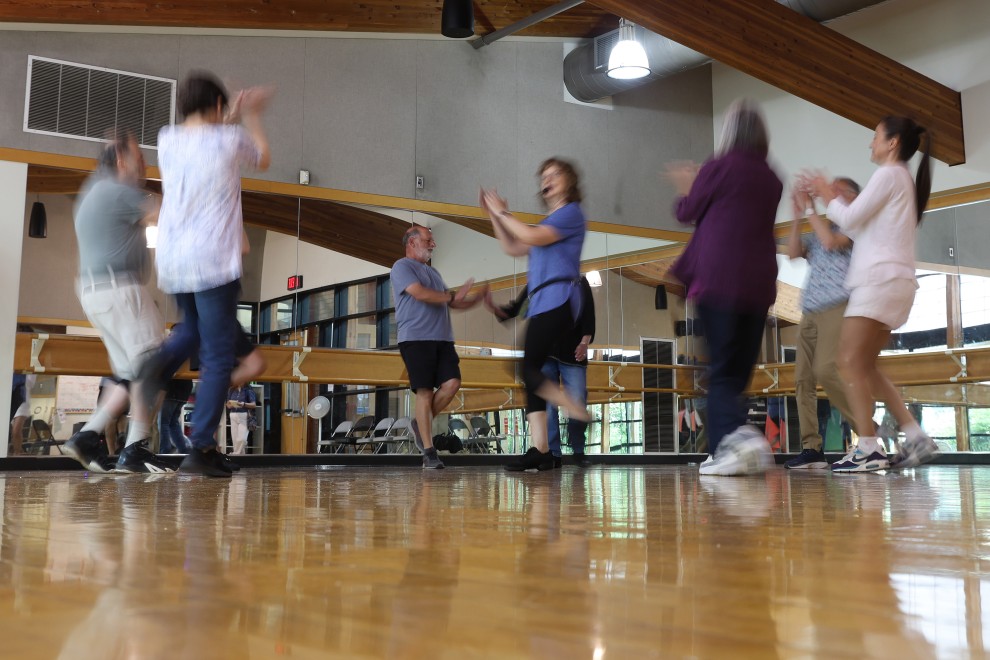
PHOTO: Portland dancers follow along with instructor Rhona Feldman, center, during an Israeli Folk Dancing class at Portland's Southwest Community Center Sunday, Aug. 17. (Rockne Roll/The Jewish Review)
Israeli folk dancing can be more than the dance itself – it is often a powerful way to connect in the Jewish community.
Jewish dance has brought people together since biblical times. Exodus contains the earliest reference to women dancing as worship; Miriam leads them in dance to celebrate the crossing of the Red Sea. Dance is an ongoing form of worship in Psalm 150, and the people are told to “praise G-d with the drum and dancing.”
Like Israel itself, Israeli folk dancing is a blend of traditions and choreography from Jewish communities around the world. Early days of Zionism brought the beginning of Israeli folk dancing by sharing stories and emotions found in the Jewish Diaspora through song and dance. Hora Agadati (“Hora” meaning circle dance and “Agadati” being the last name of its creator) is the first known Israeli folk dance; after 100 years, it is still a common dance.
Like the Hora Agadati, many of these dances have often been choreographed in a circle pattern. This maintains the Jewish tradition of using circle dances for celebration or religious observance.
In the 1950s and 60s, the line dance pattern was introduced, through European and American inspiration, for songs with straightforward and steady beats. There are also partner-style dances inspired by Balkan, Eastern European and Mediterranean culture. Portland-based Israeli folk dancing instructor Rhona Feldman notes that today in the community all songs have only one dance.
“Choreographers choose a song, and nobody else can create a dance for it,” Feldman said.
In the Israeli folk dancing circles, this is done through the choreographer’s informal, but widely respected, process of claiming a song. The first choreographer to announce their dance to a song will claim it. Announcing this claim can be as simple as posting to social media or as formal as presenting it at a live performance through festivals or workshops. Because of the tight knit community, it is rare for others to compete and create dances for songs that have already been claimed.
Whether you’re a longtime dancer or stepping onto the floor for the first time, Israeli folk dancing offers a space that’s welcoming and expressive. Portlanders have found this especially important when searching for a deeper connection within the Jewish community in recent years during the Israel-Hamas War. Today, Israeli folk dancers in Portland have noticed a shift to a more vulnerable and sensitive community. Feldman reflects on the need for community in the context of today’s world.
“I think everybody’s searching for a community these days,” Feldman said. “Israeli dancing is a really great way to find one.”
During these stressful times, Jewish people around the world want to feel connected not just to the land of Israel but to each other. Many turn to dance to feel this connection. Another longtime instructor, Debbi Montrose, has seen the Pacific Northwest’s Israeli folk dancing community grow and evolve through the decades.
“Israeli folk dancing is alive and well in Portland. It is dynamic. It is not old-fashioned. It’s constantly being revived,” she said.
In Portland, dancers gather together daily to learn new dances and join open dance sessions. While some may not speak Hebrew or understand the lyrics word for word, all find joy and connection in the dance. Some participants are joining for the first time and others have been practicing Israeli folk dancing in the Pacific Northwest for more than 50 years. Dance instructor Sue Wendel grew up in Portland and first discovered Israeli folk dancing at what was then Wilson High School in Southwest Portland.
“I was like a fish to water,” Wendel said. “I really haven’t stopped dancing since. It’s just a great way to be together with people.”
This philosophy of continuing to dance after making a wrong movement is one that the Israeli folk dancing community embraces. Like other folk dancing groups, they believe the joy of the dance outweighs the importance of pointing out a mistake.
During her class, Feldman tells attendees, “there are no mistakes, only solos.”
Israeli folk dancing is known for its accessibility. Beginners generally find learning the new dances achievable because the choreography contains simple moves and repetitive steps. Movements often include familiar actions such as swaying or performing a box step. Portland dance instructors teach inclusive classes with all levels of dance practice in mind.
Allison Victor has taught in what she calls this “vibrant community” for many years and enjoys creating a friendly and welcoming space in her classroom. She takes pride in noticing what her students need and adapts her teaching style to each individual.
In early September, the 23rd Annual B’YACHAD PNW Israeli folk dancing retreat will take place in Olympia, Washington. Debbi Montrose is also the B’YACHAD administrator and says that she created the retreat for dancers in the Pacific Northwest who couldn’t make it to out-of-state workshops and open dance sessions.
“Back in the day, most of us never went to those workshops that were in Los Angeles and New York and the Midwest,” Montrose said. “So I said, ‘Why don’t we just get in our cars and we can do it Pacific Northwest-style?’”
During the first weekend, in 2001, 25 people attended the retreat. After that, dancers were hooked. The next year drew more attendees and this year about 60 to 65 people are expected to attend. Open to dancers of all levels, the weekend features open dance sessions led by local instructors from across the region. Montrose is looking forward to including beginners this year.
“We decided to incorporate something new because not only in Portland, but in other cities, I’ve noticed because of the war in Israel and wanting to support Israel, that dancing was a good opportunity because it’s not political. It’s just culturally unifying,” Montrose said. “There’s been an uptick in new dancers wanting to come to dance in our towns.“
As Israeli folk dancing continues to evolve, it remains a meaningful way for people to connect with tradition and music – as well as each other.
To learn more about Portland’s Israeli folk dancing scene and the upcoming B’YACHAD retreat, visit their Facebook group “Israeli Folk Dancing in Portland, OR” or the Portland Israeli Folk Dancing News website, sites.google.com/site/pifdnews/welcome.
Abigail Minch graduated from The University of Oregon with a degree in Journalism and a minor in Judaic Studies. She is excited to combine these two loves into writing for The Jewish Review.