
When is food more than just a meal?
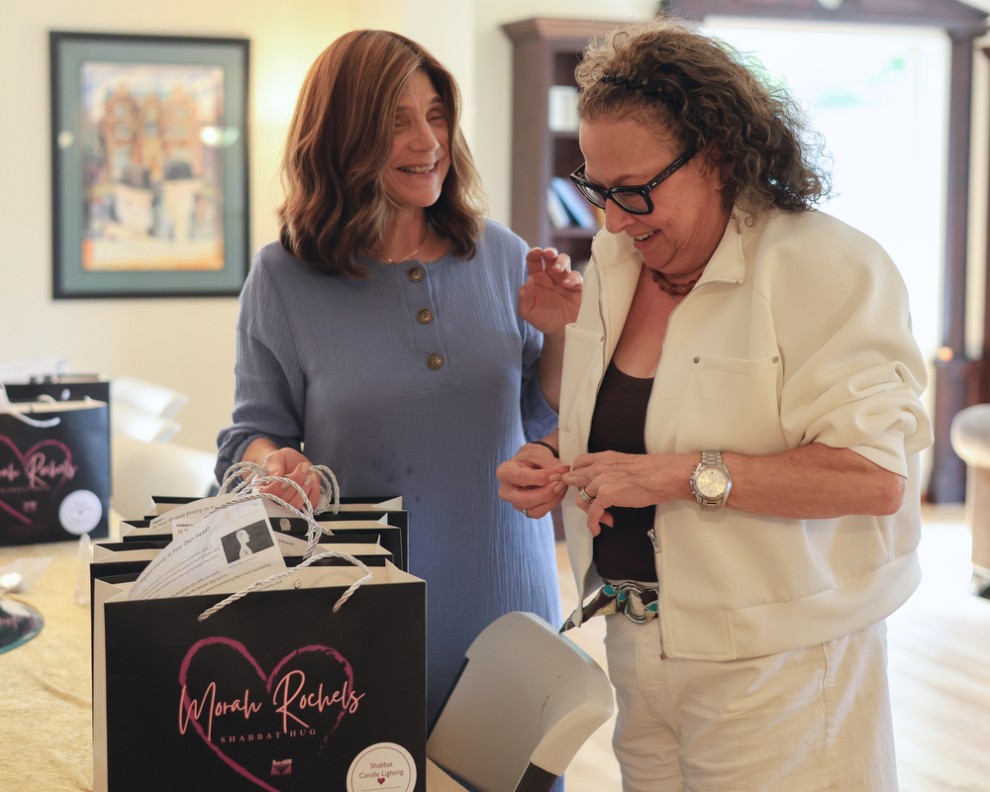
One answer to that question rests on Devora Wilhelm’s dining room table every Friday morning. Rows of small bags, each filled with a Shabbat dinner made just a few feet away; challah, soup, salad, gefilte fish, quiche or other entrees and dessert. Each also contains kosher grape juice and candles along with a printed article from Chabad’s website. A sticker on the outside of each bag provides the time to light those candles just below the name of the program: Morah Rochel’s Shabbat Hugs.
What makes these bags more than just meals is what happens next. One by one, volunteers come through Wilhelm’s door. They greet one another and Wilhelm, then take a bag or two to deliver to someone else – bringing a metaphorical hug to a fellow Jew as the Sabbath approaches.
The meal is just a gateway to a connection – a connection that often goes far beyond a Shabbat dinner.
As volunteer Darcy Rubin put it, “what starts as a mitzvah becomes a relationship.”
---
Wilhelm began making Shabbat dinner bags for those in need during the COVID pandemic.
“I was making challah and chicken soup and giving it out sometimes,” Wilhelm, the wife of Chabad Rabbi Moshe Wilhelm, explained. “But then three and a half years ago, I guess I felt that there was a need in the community.”
She started assembling Shabbat bags for a pair of families. That number has grown to more than two dozen. While some recipients truly need the food – one recipient wrote to say she stretches the food out over each weekend, which saves her SNAP benefits from running out – the need Devora Wilhelm is addressing is not merely one of sustenance.
“A goal of mine was it should not only be for extremely needy, it should be a way we honor our elders,” she said.
The recipients are identified in a variety of ways – Wilhelm gets referrals from Jewish Family & Child Service, from Chabad Rabbis throughout the area and from other synagogues. Family members from out of state are often connected to Wilhelm when their Portland-area loved ones are unwell or isolated.
In addition to a meal, each bag contains the makings of Shabbat observance – the candles, the juice for kiddush and the Chabad website article – something thought provoking or spiritually illuminating. Sometimes, those are appreciated as much as the food.
“One of the women we sent it to,” Wilhelm recalled, “I thought, ‘I bet you she doesn’t need the article.’ When I once went to deliver it, it’s the first thing she looks for. I was so surprised how much the article means.”
---
Sometimes, the most meaningful part of the delivery is the person bringing it.
Rubin left Wilhelm’s house last Friday with a bag destined for one of her regular deliveries.
“She’s a 97-year-old Holocaust survivor. And I normally go, and I’ll sit with her until her caretaker comes. We’ll talk about the news, anything. I’ve developed a really close relationship.”
Aki Fleshler was recruited to deliver a weekly bag to a man living in a care facility in the area.
“I didn’t want to bother him, I didn’t want to intrude, especially if he wasn’t feeling well,” Fleshler recalled. “He just welcomed me in. He said, ‘come in, sit down, take a load off.’ He was so happy to have company and a connection. We began a real friendship.”
That friendship continued through the man’s multiple hospitalizations and eventual passing.
“It’s a mitzvah to visit the sick. It’s a mitzvah to comfort people as they’re dying. It’s a mitzvah to accompany the dead, but it was way beyond that. It was a very deep spiritual connection,” Fleshler said.
Fleshler now delivers weekly to a man who fled the former Soviet Union after a career as a professor there – they have formed their own connection and friendship. Fleshler said there’s something unique about the person-to-person connection the Shabbat Hugs foster in a disconnected digital age.
“[Wilhelm] knows every person who’s on the list, every potential messenger, deliverer. She does a certain amount of matchmaking, not just by geography, but who would be suitable,” he said. It’s made by hand. It’s packaged by hand. I carry it by hand. I meet the person. I connect with the person.”
---
The Shabbat Hugs program emerged shortly after the launch of the Chesed Connection program run by Wilhelm’s son, Rabbi Chaim Wilhelm of Chabad’s NE Portland location. The two programs jointly received a grant from the Robison Foundation for Jewish Elders to support their operations, and each is working within Chabad’s Kitchen of Kindness to expand volunteer opportunities – including a volunteer opportunity coming up in advance of the High Holy Days. The Shabbat Hugs meals for Rosh Hashana will be additionally supported by a grant from the Jewish Federation of Greater Portland’s Women’s Giving Circle.
The program’s namesake is Rochel Chaiton, z”l, the wife of former Portland Jewish Academy teacher and Chabad Rabbi Yosef Chaiton, who passed away in 2023.
“She deeply cared about individuals and would make an extra effort to reach out to those who had no family or place to celebrate Shabbat,” her death announcement on Chabad of Oregon’s Facebook page read in part. “Her Challah and Babaganoush were legendary.”
Today, Wilhelm still strives to put a homemade challah in each bag that goes out. A core cadre of volunteers help her cook and assemble meals on Thursdays for the Friday morning deliveries. Morah Rochel’s Shabbat Hugs primarily serves those on the west side of the Willamette River, with Chesed Connection working mainly on the east side. Thus, the volunteers who carry bags from Wilhelm’s doorstep each Friday carry them as far as Hillsboro or Oregon City.
Shari Anderson lives in Oregon City; her first connection with the Shabbat Hugs program was as a recipient during her late husband’s cancer journey.
“My late husband wasn’t Jewish,” she explained. “Everybody is cared for and welcomed in the Jewish community, whether they’re Jewish or not, and so it meant a whole lot.”
Now, Anderson delivers to others in her corner of Clackamas County.
She’s taking one bag a week at present, to a woman who “right now, is not doing very well, is bedridden, and really needs the food. Her husband came out a couple of weeks ago to tell me that they really appreciate the food because they don’t have any other food.”
---
Whether it’s the food itself, the company that comes with it or the sense of connection to the Jewish community, it seems like every bag has a story about how much it means to the person receiving it.
Or to the person delivering it.
Or both.
“Sometimes you don’t realize the impact that you make on people’s lives when you do something like this,” Anderson said. “It hit me really hard how much it was appreciated and how grateful they are, and the impact that I’m having on this family by bringing them this food.”
They all mean something to Wilhelm. One story in particular sticks with her, though.
A woman who was caring for her severely disabled husband was receiving a Shabbat Hug bag every week. She was not one who would regularly chat with her delivery volunteer, but later met with Wilhelm and said something that Wilhelm made sure to write down.
“You restored my faith in the Jewish people,” this woman told her.
Sometimes, the bag is just the beginning. Volunteers have helped advocate for their recipients in elder care or medical settings, coordinated to ensure someone was regularly visiting an elderly woman with no family in the area, arranged for a family from North Carolina to visit their aging relative in Portland before the family made Aliyah to Israel and even arranging a Jewish burial for someone who had died.
For Wilhelm, who’s been a Chabad rebbetzin (rabbi’s wife) for 42 years in Oregon, that’s what’s it’s all about.
“What I’m doing really fits into [Chabad’s} mission because it’s about being there for others, spiritually, physically, emotionally,” she said. “Any way we can be there to help somebody.”
Fleshler explained it in a Kabbalistic sense, referencing Rabbi Isaac Luria’s teaching of the shattering of the divine light and the diffusion of sparks of that light into the world.
“Redemption is the process of retrieving the sparks and bringing them back. It’s a pretty famous idea; this is a big idea in Jewish mysticism. And I think that it applies here,” he said. “Maybe all this connecting is part of that same process retrieving the sparks, connecting the sparks, building a bigger and bigger light.”
Those interested in volunteering with Morah Rochel’s Shabbat Hugs, including the upcoming Rosh Hashana meals, or who would like to receive the bags, can email Wilhelm at [email protected] or by calling or texting 503-358-7000.
PHOTO: Rockne Roll/The Jewish Review