
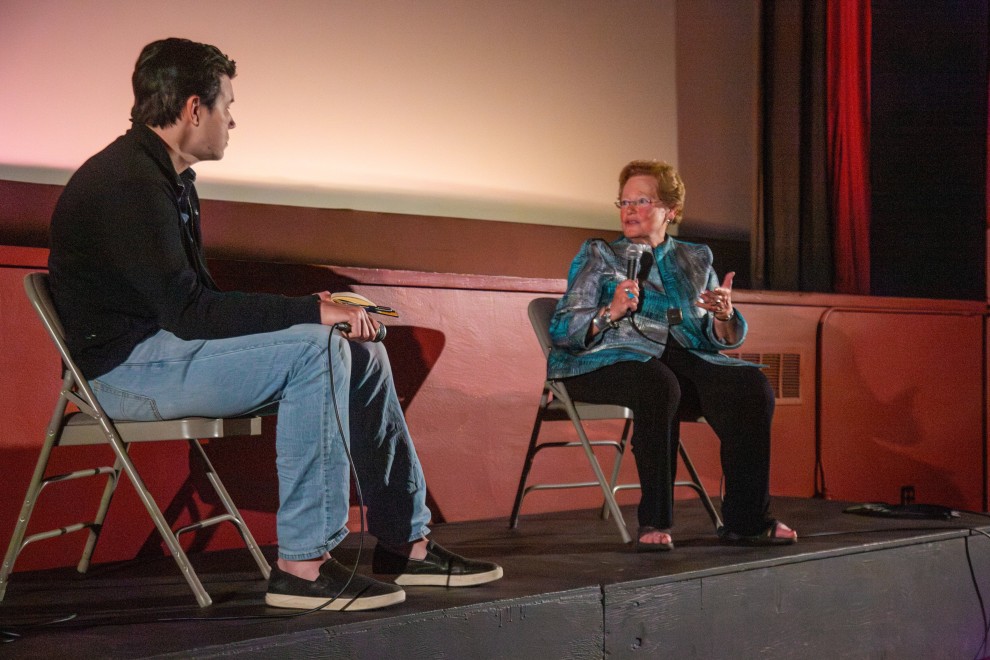
PHOTO: Abby Ginzberg, right, disscusses her film, "Labors of Love: The Life and Legacy of Henrietta Szold" with Jewish Review Editor Rockne Roll following a screening of the film at Cinema 21 in Northwest Portland Monday, May 18. (Isaac Babus for The Jewish Review)
“A woman who was more motivated than anybody that I know of…she was all about tikkun olam,” is how award-winning filmmaker Abby Ginzberg described Henrietta Szold, her distant relative, at a screening of “Labors of Love: The Life and Legacy of Henrietta Szold” on Monday, May 18, at Cinema 21 in Northwest Portland. Szold’s tremendous spirit was felt deeply in Ginzberg’s thoughtful, in-depth answers during the post-screening Q-and-A with Rockne Roll of The Jewish Review, displaying Ginzberg’s dedication to reminding the world about “the greatest Jewish feminist icon you’ve never heard of.”
“Labors of Love” shares an intimate picture of Henrietta Szold, the founder of Hadassah and Youth Aliyah, through personal stories, diary entries and reenactments. However, the most powerful moments of the film are ones that aren’t as produced or polished. “Labors of Love” tries to tie in multiple events that are pertinent to Szold’s life, but with the tight run time of 78 minutes, no section of Henrietta’s life gets fully fleshed out. The film covers her childhood, unrequited love life and travels to Palestine, along with the Holocaust, and the different political opinions within the early Zionist movement. Ultimately, moments that authentically highlight who Henrietta was, rather than oversimplifying complex historical situations, are what elevates the film.
The documentary opens poetically with an Arab grave tender caring for Henrietta’s gravestone. The striking part of this scene is the casualness of stating that Henrietta, a Jewish Zionist, is buried in East Jerusalem, a place of territorial conflict. Even in death, Henrietta strives for coexistence. Transcending the conflict, the scene evokes pure appreciation: the caretaker towards Henrietta and the audience towards the caretaker.
Later, there is the scene where a pair of doctors, one Jewish and the other Palestinian, discuss their work at Hadassah-University Hospital Mount Scopus, the institution Henrietta helped create. The two work as a team, stating the importance of treating people as people; this was a core tenet of Henrietta’s beliefs. These moments emphasize Henrietta’s desire to create unity by increasing the standard of living with the ultimate goal of binationalism.
While the film can feel disjointed between an emotional biopic and a history lesson with missing pieces, these smaller moments succeeded in showing the audience who Henrietta Szold was. She wanted Arabs and Jews to live together and forewarned that maximalism on either side would create continuous conflict. Henrietta strove for coexistence by treating every person as a human. All the places she built serve as monuments for people to come together. While she never had biological children, the thousands of children she saved from the Holocaust, the countless lives she improved with medicine, and her connection to people made her a mother to many.
“Labors of Love” may be uneven tonally, switching between personal and historical without clear transitions, but it fully envelopes the audience into Szold’s strong beliefs and incredible intelligence. Ginzsberg makes sure that Szold will no longer be the icon we’ve never heard of.
A recent summa cum laude graduate from the University of Colorado, Boulder Film School, Leah Abrahamsson is passionate about all things Jewish, film and animals. Her first published piece, “Punching Nazis” is available on the CU honors website.