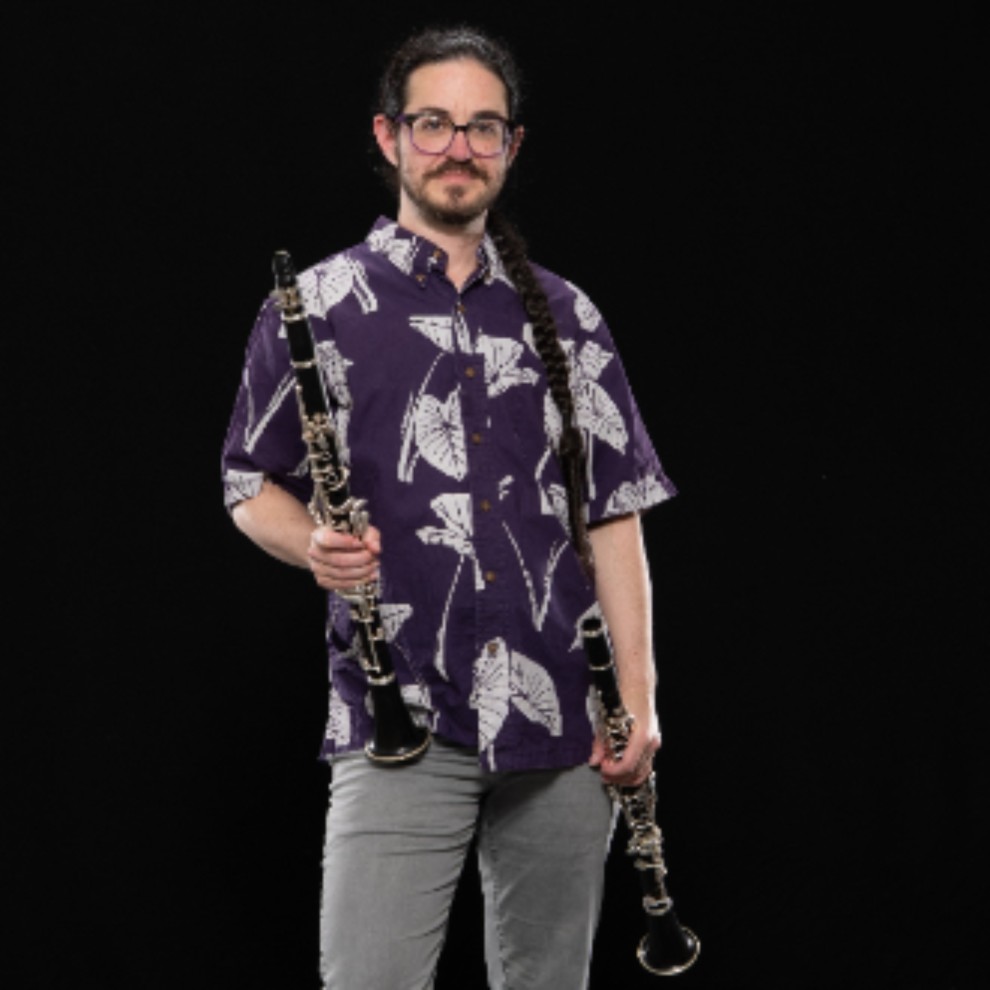
While most people know the clarinet’s place in Jewish music primarily by its influence on Klezmer, the instrument is so much more, as Portland’s Rey Abolofia can attest.
He’ll demonstrate the expansiveness of the clarinet’s impact on Jewish music in his aptly titled recital, “The Jewish Clarinet,” Saturday, Oct. 17 at 7 pm at the Eastside Jewish Commons in Portland.
Abolofia, a product of Congregation Neveh Shalom and Camp Solomon Schechter, came to the instrument at the age of 10 and hasn’t stopped since.
“I actually started because my mother had played clarinet and had one in our basement because my grandfather had bought her a clarinet,” he said, “He bought her the clarinet and then she stopped playing it, but we had one. I was like, ‘I’ll play it.’”
He played it through Portland State University, eventually earning a masters’ degree magna cum laude in clarinet performance. Abolofia also studied at the Eastman School of Music, the prestigious music institute in Rochester, N.Y., and is today the Principal Clarinet of the Salem Philharmonia Orchestra and bass clarinetist with the Sunnyside Symphony Orchestra. However, it was sometime before his love for the clarinet and his love for Judaism intersected.
“Music that we know as the like Western classical tradition came out of two places; It came out of the church and it came out of the royal courts, which are two places that Jews either didn’t want to go to or were not allowed to be,” he explained. “You play Bach and you study Bach and everything’s a cantata about Jesus. I would say it’s been kind of challenging actually to bring the two together and part of this recital is to bring the two together in a deliberate way and then invite others to be a part of that connection as well.”
While the program leads off with a clarinet and piano arrangement of “La Forza Del Destino” by the non-Jewish Giuseppe Verdi, the rest of the pieces together comprise an exploration of the full influence of clarinet on Jewish melody. “Four Hebraic Pictures,” by composer and former New York Philharmonic clarinetist Simeon Bellison, leads into a trio of pieces by George Gershwin for piano and clarinet and will be followed by French-Jewish composer Darius Milhaud’s “Duo Concertant.” Lee Melaugh will perform on the piano.
“Almost all of the pieces are 20th century, and all of the composers lived, at least for the latter part of their lives in the United States,” Abolofia observed, “I think that alone tells a very, very interesting story.”
The star of the program, however, is Steve Reich’s “New York Counterpoint.” Written in 1984, it is written as a solo performance for 11 clarinets, realized through prerecording.
“You pre-record 10 clarinet parts and then play those through speakers while you then perform the 11th part live,” Abolofia said. “Originally, [Reich] conceived it as two speakers plus the performer. But we’re going to take it one step farther. We’re going to do 10 speakers plus a performer. This is why I’m really excited we’re doing it at EJC is because that space is perfect for it… We’re going to put them in a circle around the audience. and have each clarinet part piped to its own speaker.”
“New York Counterpoint,” written to capture the vibrancy of its namesake, is around 11 minutes in length, but required multiple hours of finished recordings by Abolofia. Sound designer Cory Johannsen helped assemble the tapes and design the speaker array.
“My mom ended up buying me the score for it and at the time, in 2005 or whatever, it was quite expensive. So, thank you, Mom. It’s basically sat on my shelf for the next 20 years until I was able, until now,” Abolofia said. “The barrier that’s always been there for me has not been the music or the notes or anything like that, it’s been the speakers and audio setup.”
EJC isn’t just the ideal venue from a sound design standpoint, he explained. Many of the audience members at his recitals at Portland State University were friends of his mother’s from Neveh Shalom, and he wanted to create an event where they would feel welcomed – not always the easiest sell for many modern classical recitals, which are often held in churches.
“Churches are very open to you hosting a music recital in them,” Abolofia said, but “there’s some type of uncomfortability in that. I specifically want to put this on in a Jewish space.”
Tickets for “The Jewish Clarinet” are $18 per person, with ages 12 and under admitted for free, and are available at events.humanitix.com/rey-abolofia-the-jewish-clarinet.
PHOTO: Norm Eder/Courtesy of Rey Abolofia