
Early childhood education can be a challenging field; putting “Jewish” in front of that doesn’t change that. Jewish early childhood education is, however, a huge part of Jewish life for many children and their families, as well as the entirety of Jewish community.
“There’s so many families that grow up Jewish, but they may not have entered a synagogue since the bar mitzvah, and they’re getting reintroduced to a different type of Judaism,” Sasha Kopp Hass, the Senior Director of Education and Engagement at ElevatEd, explained, “a very sensory-based, hands-on model through their children.”
Helping educators in Jewish early childhood spaces thrive is where ElevatEd comes in. Launched as a partnership between the Jewish Community Centers Association of North America, Jewish Federations of North America and the Union for Reform Judaism, ElevatEd launched in Portland as part of its third cohort of communities. As part of that rollout, Kopp Hass and ElevatEd Executive Director Dr. Orna Siegel were in Portland meeting with stakeholders about the work they’re embarking on.
In their visit, Siegel explained, “We’ve seen really high-quality education here, and that’s not the case in every community. So that’s exciting and extraordinary, and it’s very affirming to do this work because you want to support excellent schools and help them just get better.”
Both Siegel and Kopp Hass are longtime early childhood educators – Kopp Hass recalled that her first experience in the field was while she was practically still in early childhood herself, creating Passover activities for her younger cousins as a 4-year-old before going on to serve as the assistant preschool director at Central Synagogue in New York and working with the Jewish Education Project.
“At each one of these steps, I really saw that my peers weren’t going into this field, and it was really hard to hire new teachers,” she said.
Finding and retaining teachers remains a major issue in the ECE world – Jewish and otherwise. ElevatEd provides tools to make that process a little easier.
“We have lots of national resources, but then we also have people like [Jewish Federation of Greater Portland Director of Community Programs and Engagement] Jamie [Hogland], who is our Community Coordinator, to help translate those services locally and to also be a voice back to us to say, ‘Hey, this isn’t working for Portland. We need more of this for Portland,’” Siegel said. “Every community coordinator is really our translator in both directions to make sure that we are serving the needs of each community in the way that they need to be served. “
These include tools to streamline hiring processes so qualified candidates aren’t snapped up by other operations while hiring managers – usually preschool directors – are supporting children and their staffs. These also include tools for current teachers to feel more empowered and knowledgeable in their work because, even in states where there are coursework requirements for early childhood educators (Oregon is not one of those), a lot of the job’s skills have to be picked up in the field.
“Our interventions are helping recruit and helping upskill those people new into the field, so they feel confident and competent,” Siegel said. “Adults don’t like to come to work every day and not know what they’re doing and feel overwhelmed, right? That’s not a good feeling.”
A big part of this is ElevatEd’s mentorship program – which ends up often being as valuable for the mid-career teachers ElevatEd trains to be mentors as it is for the newer mentees.
“One of the challenges with early childhood is there’s not a tremendous career path for growth, and this offers that career path and that growth so that they can learn to be reflective practitioners,” Siegel said. “They might want to stay in the field longer and certainly add back, give back to their community. They see themselves differently as leaders in their community.”
“They’re getting the opportunity to have deep learning,” Kopp Hass added. “How to have relational conversations, give and receive feedback, do observations, collect data and work with someone to help them grow. What we’re seeing is it’s not just improving the new emerging educators’ ability to be confident in the classroom, but we’re also seeing more reflective practice and just renewed energy in our in our mentors who are trying this new methodology of how to be a mentor in this classroom. It’s been really exciting to see their growth.”
This mentoring and opportunities for growth are also a boon for the approximately half of early childhood educators working in Jewish spaces who are not themselves Jewish.
“What we really want is that ElevatEd can be a resource for everyone, no matter what their background is, to learn about Judaism, to feel comfortable asking questions and to connect with others who are like them,” Kopp Hass said. “I feel like many people think it’s an anomaly that they are a non-Jewish person working this Jewish space, and it’s really something that’s happening everywhere across the country.”
That pays dividends far outside the walls of a preschool classroom.
“What we’re really doing is building allyship, and the Jews need allies right now. We always need allies, but right now, it’s really important,” Siegel added. “It’s a tremendous boon to the Jewish community to have these individuals working in our community, and to even have the non-Jewish families in our schools learning with us and becoming excited about Judaism and the Jewish people, and to become tremendous allies.”
That leads to stronger communities – both within preschools and beyond.
Quality Jewish early childhood education “creates community,” JFGP Chief Planning Officer Rachel Nelson said. “If you have teachers that are happy, they stay. You have families that are happy, that stay long-term, and that leads to continuity, and that leads to deeper engagement on both sides of the community, both the professional side and families.”
“I really do believe that early childhood is the engine for communal vitality,” Siegel added. “If we want to have strong day schools, strong camps, strong JCCs, strong synagogues, strong federations, it starts when we serve a family when their first child goes into care.”
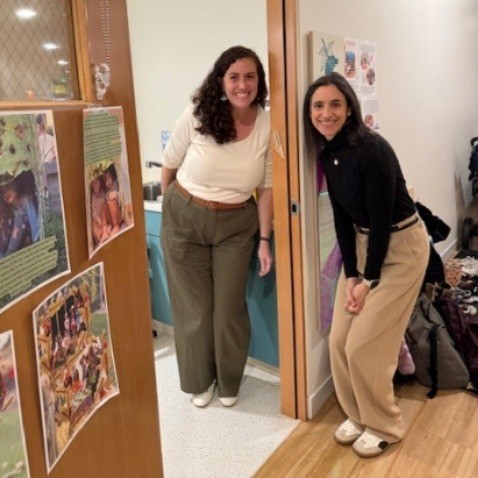
PHOTO: From left, Kopp Hass and Siegel. (Jamie Hogland/The Jewish Review)