
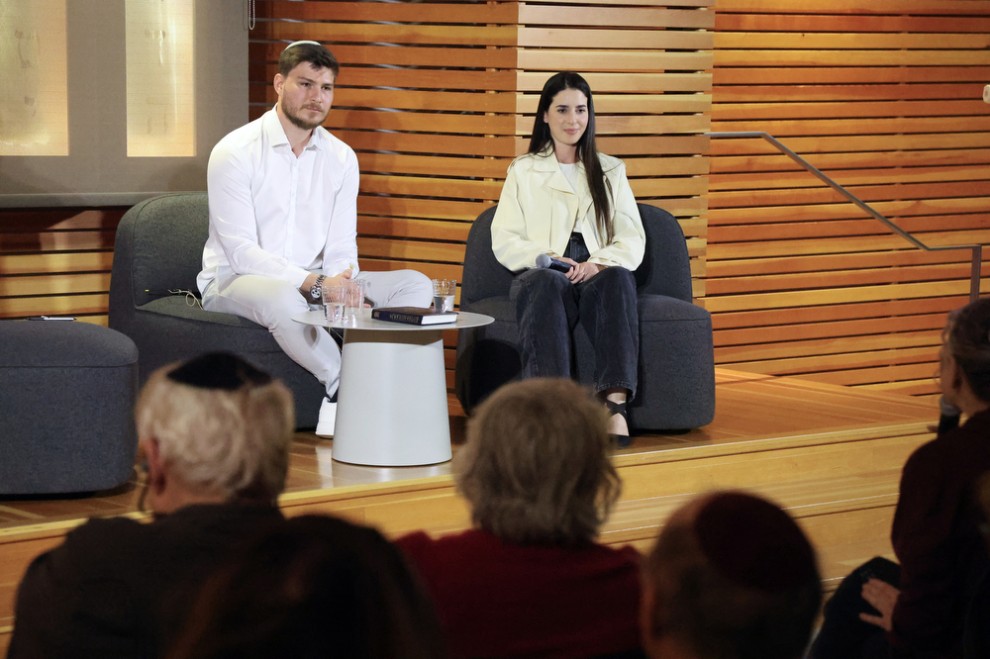
Rabbi Shmulik Greenberg explained to the audience assembled at the Chabad Jewish Center of Clark County on Tuesday, Oct. 13, that what they were witnessing wasn’t just a presentation – it was a miracle.
“This is not just a story we read in the news. This is a living miracle that we have the privilege of witnessing with our own eyes,” he said.
He was speaking of the evening’s guests, Sasha Troufanov and Sapir Cohen. The pair were kidnapped from Kibbutz Nir Oz during the Oct. 7 attacks and held as hostages in Gaza; Cohen for 54 days, Troufanov for 498. The experience was transformative for both of them.
“Before Oct. 7, I didn’t feel a part of our nation,” Cohen said.
They were at Nir Oz to visit Troufanov’s parents when Hamas terrorists breached the compound.
“In that moment, I took a blanket, I put it over myself,” Cohen recalled. “I decided that I didn’t want to see anything, and we hid under the bed because there is no place to hide there.”
“One of those terrorists came towards me and just punched me straight to the face while the others were preparing their weapons,” Troufanov said.
Cohen was placed on a motorcycle and taken to Gaza. Troufanov tried to make a break for it.
“I managed to push them and started running. I remember the terrorists shooting at me from behind,” he said. “I heard the bullets just whistling near me I remember the shouts in Arabic all around me.”
A bullet shattered his left leg, leaving him unable to stand. Eventually, he too, was taken to Gaza on a motorcycle, as was his mother. His father was murdered on the kibbutz.
Cohen recalled her first days of captivity.
“I was with two other hostages. One of them was a man who just laid down all the day and closed his eyes, and the second one was a young girl, maybe 16 years old,” Cohen recalled. “I remember that when I saw her, she was crying and she was shaking, and then she said to me something that, after, I felt completely different; she told me that all her family was in the kibbutz on Oct.7 and she said, ‘Sapir, I’m not sure that I have family anymore.’”
Troufanov, meanwhile, was entirely alone except for his kidnappers. They eventually had to take him to a hospital to treat his shattered leg.
“They didn’t speak any English. I didn’t know Arabic at this point, so I couldn’t even communicate with them,” he said. “They put me in a small storage place in the hospital itself. And then came a nurse. I remember the look in his face when he needed to take care of me. He was so disgusted. He didn’t want to do it, but they forced him to because they wanted me to heal from my injuries, to serve as a hostage.”
The Israel Defense Forces came very close to his position during a raid, but they were not able to find him. Troufanov and the terrorist responsible for him hid out in a building as the IDF patrolled the area.
“The terrorist came close to my ear and whispered to me,” Troufanov said. “’ You can do whatever you want. You can pray. You can hope. I don’t care. As long as there is no rain to serve as a cover for us to run, we are staying in this place for this night as well, and you will probably get killed here.’”
Troufanov said he prayed for rain – rain which soon appeared, and he was taken away again to a house with a wooden cage he was kept in. Later, he was moved into a tunnel nearly 100 feet below ground.
“Immediately when you walk in, you can feel the smell. It’s so stinky. It’s a mixture between mold, humidity, and feces,” he said. “The hardest things for me were the silence and the darkness. In this tunnel, I spend many hours, sometimes even weeks, by myself without anybody. And in the tunnel, there is no sound at all. You can hear a cockroach walking on the floor.”
Cohen was released after nearly two months. The people she had been held with were not so lucky.
“I discovered that eight of the hostages that I met in Gaza were killed,” she said.
Cohen connected with Troufanov’s mother, who learned that her husband was dead and her son had been kidnapped.
I decided that the best thing that I can do is just to go and to live with her in the same hotel and to be like a family for her,” Cohen said. “I remember that sometimes she came to me and she said, ‘Sapir, I don’t want to live anymore. It’s too much for me. I have nothing in this life.’ I didn’t know what I can say to someone in this condition, so I started to promise her grandchildren.”
Five months after the attacks, Palestinian Islamic Jihad released a video which included Troufanov. Cohen said it weas a day of celebration for her and Troufanov’s mother.
“Sasha mentioned me in this video, so I was very excited. But three months later, they published the second video, and in this video, Sasha didn’t mention me,” Cohen recounted. “I spoke with [his] mother about it. She said, ‘He had to say what they told him to say.’ But I said, ‘no.’ I knew that Sasha wanted to release me. And when he came back, I asked him about it, and he said this sentence: ‘Sapir, I didn’t want you to wait for someone that will never come back.’”
Troufanov said that the day of his release was emotionally complicated, because it was also the day that he confirmed that his father was dead. But his experiences stayed with him.
“I remember that when he came back from the captivity, the first sentence that he said to us is, ‘Mama, I know that God exists,’” Cohen recalled.
“At first, I was so, so desperate. I couldn’t cope. I remember for weeks I just was so miserable. I said to myself, ‘What happened to me? Why did God put me to this challenge?’ I didn’t even believe in God at that point, but I still questioned him,” Troufanov recalled. Suddenly, something within myself said, ‘You must find something positive to think about. It doesn’t matter what but try to reflect about something good.’ I remember I took time for myself, closed my eyes, and just started to think about my mother and Sapir, my father that I didn’t know was dead, and my grandmother. I knew they were hostages, and I started to wish them well. I wished them everything good that I could have think of, something that would help them go through this ordeal… When I opened my eyes, I felt so much strength within myself. Although I prayed for somebody else, it strengthened me, and it was obvious from the beginning. So, I decided to do that every single day, many times, and every difficult challenge that I need to face, I remember that the first thing I did is just pray for God to help me go through that.”
Cohen had not been much for prayer before her kidnapping, either, but in the month leading up to Oct. 7, she had been experiencing mysterious health issues and anxiety. She started to recite from Tehilim, the book of Psalms, each day – specifically Psalm 27 – each day for a month.
“I decided to focus on the words that I’m saying,” she explained. “I realized that the chapter is not about a complete recovery; it’s related to war and God saving from enemies, I just ask myself, “from which war am I going to be saved?’
The couple – who were on the verge of breaking up before their captivity, Cohen explained – are now married, have become Shabbat observant (which Troufanov had not been before) and are on tour sharing how their experiences have strengthened their connection to each other and their people.
“Everybody has a different direction they took in order to find their path to Judaism,” Troufanov said. “But we need to stay strong.”
PHOTO: Rockne Roll/The Jewish Review