
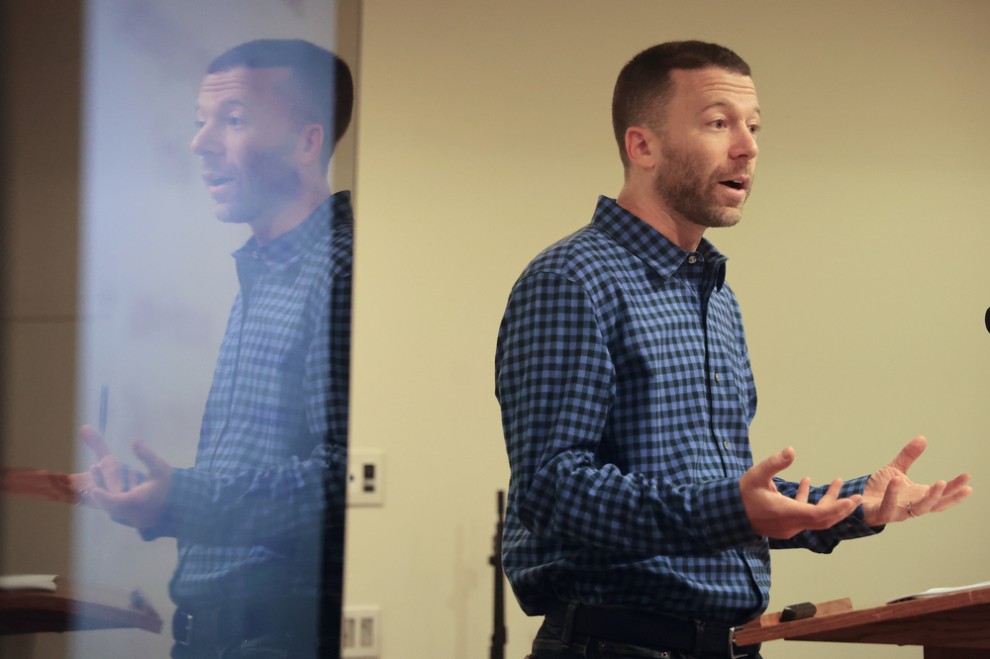
For the Jewish Federation of Greater Portland’s Fourth Annual Preschool Day of Learning, keynote speaker Dr. Noah Hichenberg suggested something bigger than what might otherwise come out of a professional development program.
“Your children are so smart, so creative, so relentlessly generative, so eager to help, to participate, to pitch in, and yet so much of our time is spent shuttling them from activity to activity, and telling them what to do,” Hichenberg said in his address Friday, Aug. 28 in Congregation Neveh Shalom’s Birnbach Hall. “So how did we get here? How did we get to hovering parents and teachers interrupting children? Why do we have such a hard time trusting children? Why are we so focused on controlling them” What happened to participation and contribution?”
Those questions became the subject of Hichenberg’s doctoral work at Columbia University’s Teachers College and the subject of his book, “A New Vision for Early Childhood: Rethinking Our Relationships with Young Children.” As he explained to the crowd of early childhood educators and preschool staff from around the Portland Area, the answer is surprising, but not complicated.
“It turns out child development is actually a social mechanism, not isolated within the individual biological child. Childhood is cultural,” he said. “This was news to me as a preschool teacher. I simply did not know this. It was not covered in the coursework or the credits given to me in my teacher training sessions.”
Elsewhere in the world, young children contribute to their families and communities from a very early age. This has been the state of things since the earliest hunter-gatherer societies.
“The industrial revolution towards the end of the 1800s forever changed this. It changed the relationship between children and the world that they were a part of, as for the first time in our species’ 200,000-year history, the children were removed from the intimate daily activities of the adults around them. This changed our species. It changed childhood,” Hichenberg explained. “This isn’t necessarily a good thing or a bad thing; it’s just a thing that led to this.”
“This” is the field of Early Childhood Education. It’s also the realities of age-segregated classrooms, academically derived childhood development standards, and anxious parents.
“We came to believe that if we only watched our children always, we could perfect their childhood. We could prevent them from ever falling, from ever failing. But this constant surveillance has had a perverse effect. It further removed children from the world, closing them off in these newly termed developmentally appropriate spaces, of which there had previously been zero,” Hichenberg said. “Childhood became sanitized, and children became useless.”
For his dissertation, Hichenberg performed a year-long ethnographic study of a New York City toddler with the pseudonym “Emily.” Over the course of her first year in preschool, Hichenberg spent more than 100 hours with Emily, resulting in 1,400 pages of transcribed conversations between her and the people in her life.
Hichenberg concluded, he said, that “age-based segregation, over-infantilization, and constant surveillance-it all left very little room for Emily to actually accomplish much, for her ideas to come to fruition, for her agency to shine, for her contributions to matter.”
The surveillance is pervasive – Hichenberg cited a piece from The Atlantic’s Hanna Rosin on parenting where she and her husband realized that their daughter had, by age 10, experienced a cumulative total of less than 10 minutes without adult supervision.
Age segregation is not only evidenced by the post-industrial separation of kids from adults, but the separation of kids from other kids. As for infantilization, Hichenberg asked a question: “Have you ever tried, you personally, to use you know the plastic knife that we give toddlers, like the colorful one from IKEA. Have you ever tried to cut meat with that? Have you ever tried to cut fabric or cardboard with the scissors available to your toddlers?”
There’s a fix, though, and preschool teachers like those in the room have a big part to play in that fix.
“Childhood is cultural, and the cultural space that matters most to the child is your classroom. You can impact this. We can move away from vertical relationships defined by control and surveillance, and toward horizontal relationships defined by trust and reciprocity,” he said. “I’m not saying we need to give children the keys to the car and the credit card, although that would be perhaps exciting as well. I’m not just saying though. I’m not just saying that we need to flip the verticality. I’m saying we need to shift this orientation into a horizontal relationship, one in which we can look across at children instead of down at them, one in which trust, mutuality, and reciprocity can define the relationship.”
It’s not an equal relationship, but it’s not a dictatorial one either.
“You are in a position of earned authority, of accrued wisdom, of more cycles on this earth than the younger humans under your care,” Hichenberg said. “Use that wisdom. Bring your expertise, but don’t let it mean that you are always right.”
This kind of approach builds trust. That trust enables all the other work preschools can do – the kinds of work that were discussed in breakout sessions later in the day about music in classrooms, volunteerism in schools and more.
“We can use this trust to build curriculum in our classrooms that reflects back to the child, ‘You matter. Your ideas have value here. Your presence contributes to the things we do here,” Hichenberg continued. “Believe me, I’ve seen this happen enough times that I know that it’s real, that it works, and that children and families are desperate and thirsty for it. Children want to matter. They are tired of being useless.”
PHOTO: Rockne Roll/The Jewish Review