
Later this fall, a week before American voters go to the polls in what has been widely billed as one of the most consequential elections in the country’s history, Israeli voters will take their own turn at a historic election.
All 120 seats in Israel’s Knesset (parliament) are up for election Tuesday, Oct. 27, in the first Israeli general election since the Oct. 7 terror attacks. The Jewish Federations of North America are hosting a series of webinars on the elections to help American Jews understand Israel’s complicated politics.
The first, a conversation between JFNA President and CEO Eric Fingerhut and Haviv Rettig Gur of The Times of Israel and The Free Press, was held Wednesday, Sept. 9. This will be followed by “One Week Until Israel’s Elections” with Miri Eisen, a retired Israeli military intelligence officer and the former foreign media advisor to Prime Minister Ehud Olmert, scheduled for Monday, Oct. 19. The series will conclude with “24 Hours After the Results: What Do We Know?” on Wednesday, Oct. 24 with Rettig Gur. Both webinars will begin at 11 am Pacific Time.
“We understood that the Israeli election is a really important event that is complicated, and we wanted to make sure that everybody in our community had the chance to fully understand what was going on,” JFNA spokesman Niv Ellis said. “Every time an election comes about, it’s sort of similar: a lot of the same questions come up, and folks are interested anew in the system and how it works. It’s obviously very different than the systems in the United States and Canada. And of course, a lot has happened in the Israeli political system since the last election. So, people really want to understand the dynamics and get a better sense of what’s happening.”
Rettig Gur explained in his Sept. 9 conversation that despite the two countries vastly different political systems, dissatisfaction with established political parties has become a major aspect of both US and Israeli politics.
In the US, Rettig Gur said, “the parties have become more national, and consciousness has become less local and more national because everybody’s online. So that’s led to much more not liking the party because the party has become this sort of national uniform movement rather than my local democratic party that would deal with my local things. In Israel, all parties are national. There’s no local politics of any kind.
Nevertheless, and even with 38 parties running in the upcoming election as opposed to two major parties and a handful of fringe candidates in US elections, Israelis don’t seem to like their options.
“There was a study out of Israel Democracy Institute in the last year where if I’m not mistaken 60 percent of Israelis don’t find themselves represented in in in the way they want to be in any of the parties available to them,” Rettig Gur said.
Fittingly, none of those 38 parties are expected to receive a majority of the votes – every Israeli government has been a coalition of multiple parties. Israeli voters cast ballots for a party directly as one nationwide electoral district, and each party has an ordered list of candidates who will be elected to the Knesset depending on what percentage of the vote the party gets. A party must receive at least 3.25 percent of the vote to receive seats, a tally which would be good for four of the 120 seats.
The major players in the upcoming election are Likud, the long-established party of incumbent Prime Minister Benjamin Netanyahu, along with Yashar, led by former Israel Defense Forces Chief of Staff Gadi Eisenkot, and Together, co-led by former Prime Minister Naftali Bennett and current opposition leader Yair Lapid. An average of polls over the last week showed Likud and Yashar each receiving 23 seats, with Together netting 12. As none of those figures are close to the 61 seats needed to form a government, the showings of smaller parties and the negotiations between party leaders after the votes are counted will be crucial.
Those smaller parties include left-leaning groups like The Democrats as well as far-right factions like Otzma Yehudit, the party of National Security Minister Itamar Ben-Gvir. There are also parties oriented toward the interests of Haredi (sometimes referred to as “ultra-Orthodox) voters such as the Sephardic and Mizrahi Shas and the Ashkenazi United Torah Judaism parties, as well other Orthodox voting interests like the Religious Zionist party of Finance Minister Bezalel Smotrich. Complicating factors further are Arab parties Ra’am and the handful of parties who campaign together as the Joint List, which are almost never invited into governing coalitions but receive the support of the overwhelming majority of the country’s Arab citizens. The same average of polls showed 11 parties, including all of those listed above as well as Yisrael Beytenu, which has traditionally advocated for the interests of Russian immigrants, as receiving enough seats to enter the Knesset.
However, Jewish Federation of Greater Portland Chief Community Relations and Public Affairs Officer Bob Horenstein warned, “Israeli polls are notoriously, notoriously incorrect. So don’t ever trust Israeli polls. I think they probably underestimate the Haredi vote, maybe even the Arab vote.”
In previous years, the minimum vote percentage to receive a Knesset seat (called the electoral threshold) was as low as one percent. The increase was meant to diminish the power of fringe parties, but Rettig Gur explained that effort has backfired somewhat.
“Increasing the threshold is meant to throw out of the conversation of the politics the edges, the crazies, the marginal ones, the ones with strange voices that just will hold everyone else ransom,” he said. “What we’ve actually done is massively empowered them because we’ve created a larger pool that could be lost to either camp, and so both camps are now trying to push as much of that in as possible, so the edges have actually become more powerful. Be careful when you reform a political system. It’s a complicated machine.”
This year’s elections are also unusual because while the Knesset can legally sit for four years between elections, it rarely crosses this finish line. The most recent election, in 2022, was the fifth in four years.
“Usually what ends up happening is some internal dynamic causes a coalition to fall and early elections to be called,” Ellis said. “This is the first time in decades that we’ve actually had four full years since the last election.”
The necessity of building a governing coalition, and the diverse possibilities of what that might look like, are why the last webinar in the series is being held after the election, Ellis explained.
It’s not always clear exactly who will be the prime minister, who will be in the government, who will be the ministers, what the policies are going to be,” he said. “So, it was really important for us to also have a moment to assess that and sort of what the likely outcomes are the day after the election when things are still very much in the air, even when the votes are counted.”
Registration for both upcoming webinars, as well as other JFNA resources on Israel’s elections, are available online at jfeds.org/m/IsraeliElectionSeries2026
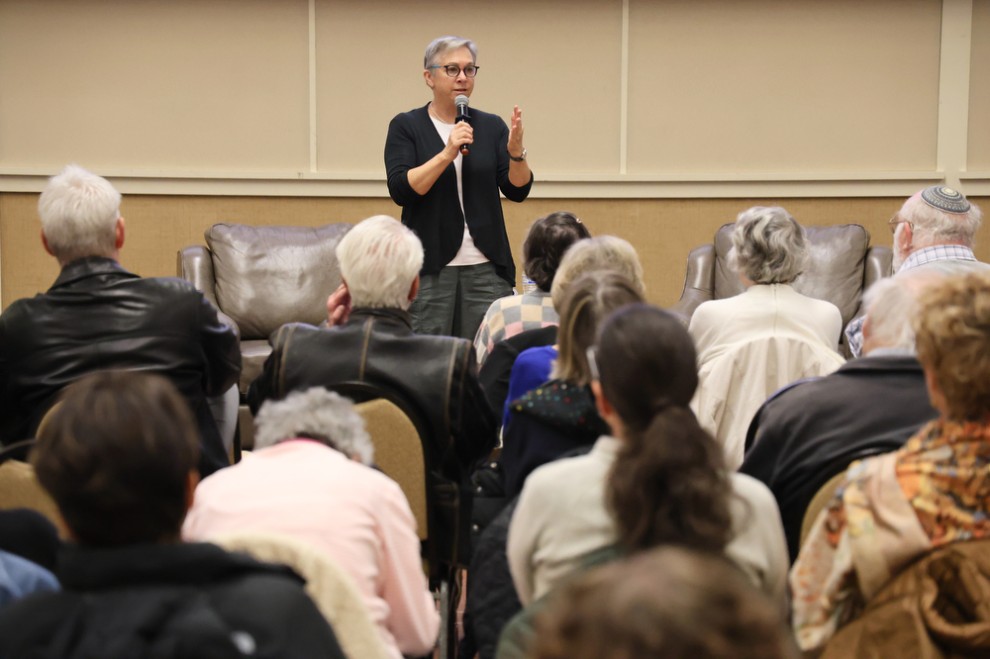
PHOTO: Miri Eisen, the presenter for JFNA's second Israel Election webinar, speaks in Portland earlier this year. (Rockne Roll/Jewish Review file)