Summer is the time for many activities – gardening, baseball, and the Jewish Federations of North America’s campaign leadership mission.
Wendy Kahn, the Jewish Federation of Greater Portland’s Chief Development Officer, and Jack Birnbach, the co-chair of the annual campaign, were prepared to hit the road together once more – first to Paris, then to Israel, visiting programs and people that are the beneficiaries of the funds JFNA distributes to support Jewish communities around the world.
Circumstance altered their travel plans.
“A couple of weeks before [we left], there was the war with Iran,” Birnbach explained.
Over 12 days, Israel struck targets throughout the Islamic Republic of Iran in an attempt to neutralize its nuclear weapons program. Iran responded with missile and drone strikes against Israel. Israeli air space was closed and Ben Gurion International Airport was shut down.
“We couldn’t go even if we wanted to go, because there was no way to get there,” Birnbach added.
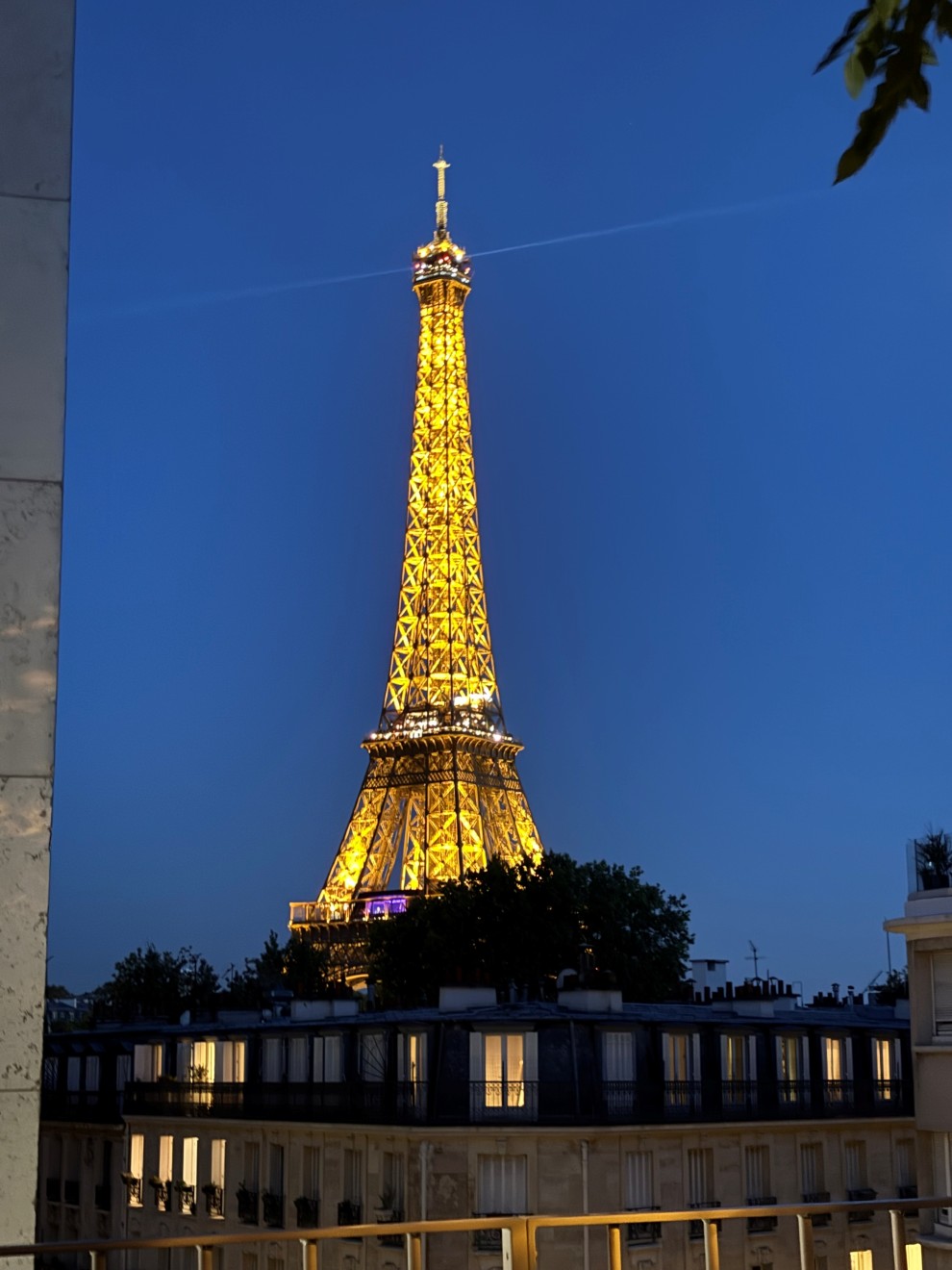
Instead, volunteer campaign leaders and professional development staff from throughout North America spent Monday through Thursday, July 7-10, in and around Paris, connecting deeply with the French capital’s Jewish community and the enormous challenges they face.
“France has such high level of antisemitism, and they have, within the community, ways to respond to that antisemitism,” Kahn said. “We’re experiencing such high levels of antisemitism in the United States, so we wanted to take that knowledge back into our individual communities and start localizing those learnings and tools and add to the responsiveness that we have.”
-
At a dinner during their first evening in Paris with the Israeli ambassador to France, Joshua Zarka, Kahn spoke with a family that was responding to that antisemitism in the same way approximately 20 percent of French Jews are – by leaving; in their case, to make Aliyah. The family were presented with Israeli passports at a ceremony during the dinner. Kahn talked with the father, using Google Translate on her phone, about their decision to move to the Jewish state.
“We cried in our hearts and we knew that it would be hard, but one has to be patient, and our kids will find it easier,” the man said to Kahn.
Though their children, passionate young footballers, had experienced a level of antisemitism that was relayed as “a nightmare,” the decision to move was a difficult one because while these families are proudly Jewish, they are also proudly French.
“What we heard a lot throughout the mission was the sense of French nationalism. It takes a lot for these people to leave,” Kahn explained. “I think the French are very proud people.”
-
French Jews have much to be proud about – this was on full display in Sarcelles, the suburban community north of Paris that became a hub for North African Jews in the 1950s and 50s.
“They call it Little Jerusalem,” Kahn said. “It was just filled with synagogues, Hebrew writing, kosher restaurants.”
The restaurants were a notable part of the experience – both in terms of quality and quantities.
“If you went away from that table hungry, it was your own fault,” Birnbach said of their lunch. “They gave us enough for three or four days.”
“It started with a smattering of dishes, and then you thought that was it. The next course came, and you thought that was it,” Kahn added. “Then chicken would come, and the lamb chops would come, and it just kept coming.”
Through the delicious haze of lunch, both Kahn and Birnbach observed the cohesion of the community there, particularly as they learned about how it went about fundraising.
“There’s one fund,” Birnbach explained. “There’s one fundraising institution.”
Synagogues and community organizations all contribute to a common fund and work collaboratively to disburse the resources that are donated.
“They’ve got this, ‘we’re all in it together attitude,’” Kahn explained. “We don’t have that.”
There were also a pair of memorials – to the 2015 shooting at a kosher supermarket in Porte de Vinvennes and to the 2012 attack on the Ozar Hatorah school in Toulouse. The memories of those attacks are not far from mind in France, as evidenced by the security that accompanied group any time they were outside as a group.
“There were four French soldiers with long guns with us and at least three Paris police, armed,” Birnbach recalled, in addition to the security detail that JFNA always provides its foreign missions. “I thought, ‘That’s nerve wracking that they needed to be there to protect us and the community.’”
-
For all the difficulty French Jews face, there’s also great joy to be found – as evidenced through a day camp program in a Paris park the group visited on Wednesday.
“They were teaching the kids Hebrew, but in a game in a gamified way. One person called it the campification of Hebrew school,” Birnbach explained. “They had Hebrew words, I think they were cities in this particular case, but they were in Hebrew, and the kids had to find other people who were in this group, including the adults who had these Hebrew city names, and get together.”
“The Tel Aviv boys were very excited,” Kahn recalled of her time holding a sign bearing the name of Israel’s second largest city. “They were dancing, ‘Tel Aviv, Tel Aviv, yeah!’”
“It was a warm day, but it felt good because we were all shaded. They were just playing,” Birnbach said. “It was a great, great time for them.”
It was a stark contrast to the memorials and the security cordon and the stories of fleeing that the previous two days had brought – par for the course in a Jewish life.
“That’s just who we are as a people, that you have to hold two truths. You have to hold the joy and the sadness and so and the kids, often, are the holders of all that, because they don’t always know,” Kahn explained. “These kids, they were silly and they were fun and they were loving and they were trusting. They were everything.”
-
The group was slated to visit a Holocaust museum in Paris the next day. Once again, circumstance had other ideas. With the visit coming just before Bastille Day, France’s national holiday, and a week before the Tour De France bicycle race completed its final stage along the Champs-Ellysse in the center of Paris, traffic was off the charts. What could have been a 20-minute walk was instead a two-hour bus ride.
“We missed that program, and what they ended up doing was like modifying it and lighting candles and having a moment outside,” Kahn recalled.
They didn’t miss an impromptu meeting with French Jewish social media personalities at Paris’ city hall. In an impassioned address, laced with profanity, a quartet of content creators charged the gathered American leadership with helping to carry the message of what they were going through.
“You need to help us. You have the money, you have the leadership, you have the connections. You must help us, because the hate, the hate and the venom that is being spread is being spread through social media, and we, the Jews, are the worst in terms of our own PR. Help us change that,” Kahn recalled them saying. “They said, basically, don’t be bystanders, help us improve our public relations on behalf of the world, Jewry and help address global loneliness, because Jews are feeling lonely.”
It’s a message that stuck with Kahn.
“All three of those things are doable,” she said, “even though the elevated language and the methodology might have been like off putting. They weren’t polite, but they are feeling under siege, and they’re feeling alone.”
After an evening cruise on the Senne with the Chief of Staff to the American Ambassador to France, Kahn recalled a conversation she had with a campaign leader from Milwaukee, Wisc., who had come to the United States from Ukraine decades ago as a single mother with $200 to her name. The conversation galvanized the message that the group had heard already.
“She uses her power and her leadership and her money as her resistance. And I’ve said that before, but I think that is why we can’t be bystanders,” Kahn said. “We can let people know, ‘Don’t stand by the sidelines.’ We all have different things that we can do. Use your voice, use your skills, use your talents, use your money, use whatever you’ve got, but nobody should feel alone and be crying at us like that. We should all be in it together.”
Being in it together – as Am Yisrael – has been one of the keys to Judaism’s continuity over the millennia. It’s trips like these that further that connection.
“One of the big takeaways is you’re supposed to get stories, and you’re supposed to use those stories to help other people understand what we do locally, nationally and internationally,” Birnbach said. “I’m trying to help people say ‘My money’s going someplace.’ It’s going to help us here in Portland. It’s going to help Jews throughout the United States. It’s helping Jews worldwide through JAFI (The Jewish Agency for Israel) and the [American-Jewish] Joint Distribution Committee. So if you’re sitting here in Portland, Oregon, saying, ‘What can I do,’ you can contribute to the campaign, because we’re going to use that money wisely; locally, nationally and globally.”