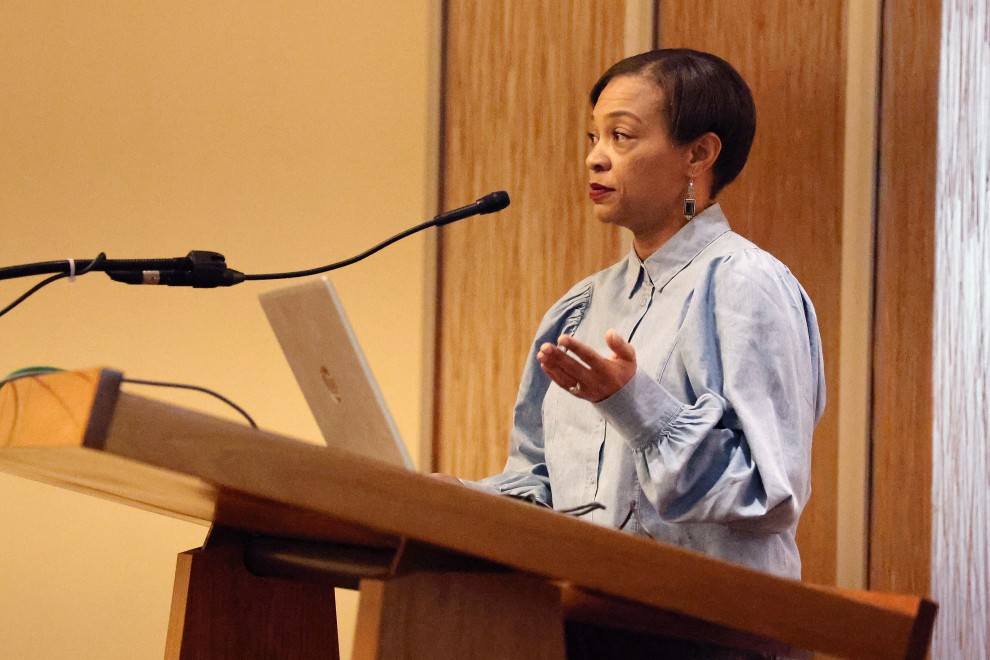
The Jewish Federation of Greater Portland hosted its latest K-12 Parent Advocacy Night Tuesday, Oct. 28, at Congregation Neveh Shalom because even if the volume of incidents in schools has diminished, the problem has not disappeared.
“So far this year, it has been a little bit quieter. Thank G-d. Hopefully it will continue that way,” Federation Chief Community Relations and Public Affairs Officer Bob Horenstein said. “But I don’t think these issues are going away anytime soon.”
One issue that was discussed was the problem of pinning down when something upsetting or even hateful crosses the line into actionable conduct and when it does not.
As Jenna Statfeld Harris, a staff attorney with the advocacy group StandWithUs explained, “Just because it’s awful doesn’t mean it’s unlawful.”
She said that when issues arise, it is important to start conversations respectfully, at the classroom level, if possible, and to not assume ill-intent. She gave an example of a leaflet from a pro-Palestinian school walkout that instructed participants to “not engage with Zionists” – administrators, not understanding how Zionism and Judaism in American actually intersect, did nothing.
“This happens a lot. Something bad happens in a classroom or on social media or in a school event, and it appears obvious to the parents or the students why the thing is bad. So, they go to the teacher or to the administration, and they say this thing was bad, and they assume that everyone knows why the thing is bad. Most of the time, that’s not the case,” she said. “Because we generally define Zionism in a much different way than folks who are anti-Israel define Zionism, we can’t assume that we’re having the same conversation.”
Because of that, issues need to be addressed by not focusing on perceived intent, but on impact to the student involved. It’s also important to document everything when looking at something problematic – including screenshots of social media posts. Resources like StandWithUs and the Federation can help figure out after the fact what is actionable and what can be done, but this process becomes much easier and more likely to succeed when what happened and how it affected students and their families can be substantiated.
Jillian Stone, a Civil Rights Support Specialist with the Oregon Department of Education, explained some of the avenues through which issues can be addressed – and how state law expects them to be addressed.
“In Oregon, we have an “Every Student Belongs” rule. This covers symbols of hate. Every school district is required to have a policy that outlines the symbols of hate such as the noose, the swastika, and the Confederate flag,” Stone said. “Bias incidents are covered in that rule. So, if bias incidents are occurring, if symbols of hate are present on school grounds, the school does need to respond.”
Bullying is not automatically something that falls under these rules, but when bullying touches on one of Oregon’s 10 statutorily defined protected classes - age, disability, national origin, race, color, marital status, religion, sex, sexual orientation and gender identity – that becomes discrimination and opens the door for more significant action. These protected classes are broader than those covered in Federal civil rights legislation.
There is a formal complaint process to address these, but it starts at the local level – it can be complicated and there can be rigid timelines involved. When the process has been completed at the school district level and a parent is unsatisfied, or if the district ignores the complaint at any point in the process, ODE’s Civil Rights Unit can get involved.
“There are multi-step processes, and so we want you to pay attention to that, too. They can differ,” Stone said. “They are going to want you to kind of start with the person that you’re having a problem with; They’re going to want you to start locally, right, with that teacher, with that staff member, and then move up from there.”
Federation staff can help navigate this process and support families locally. If your family has issues with antisemitism in school of any kind, contact Horenstein at [email protected] or Federation Director of Educational Initiatives and Associate Director of Community Relations Rachel Nelson at [email protected].