
After 33 years in Oregon newspaper, Steve Law decided to give back to his community by getting involved with Friends of Mount Tabor Park. From there, he found the subject of his book.
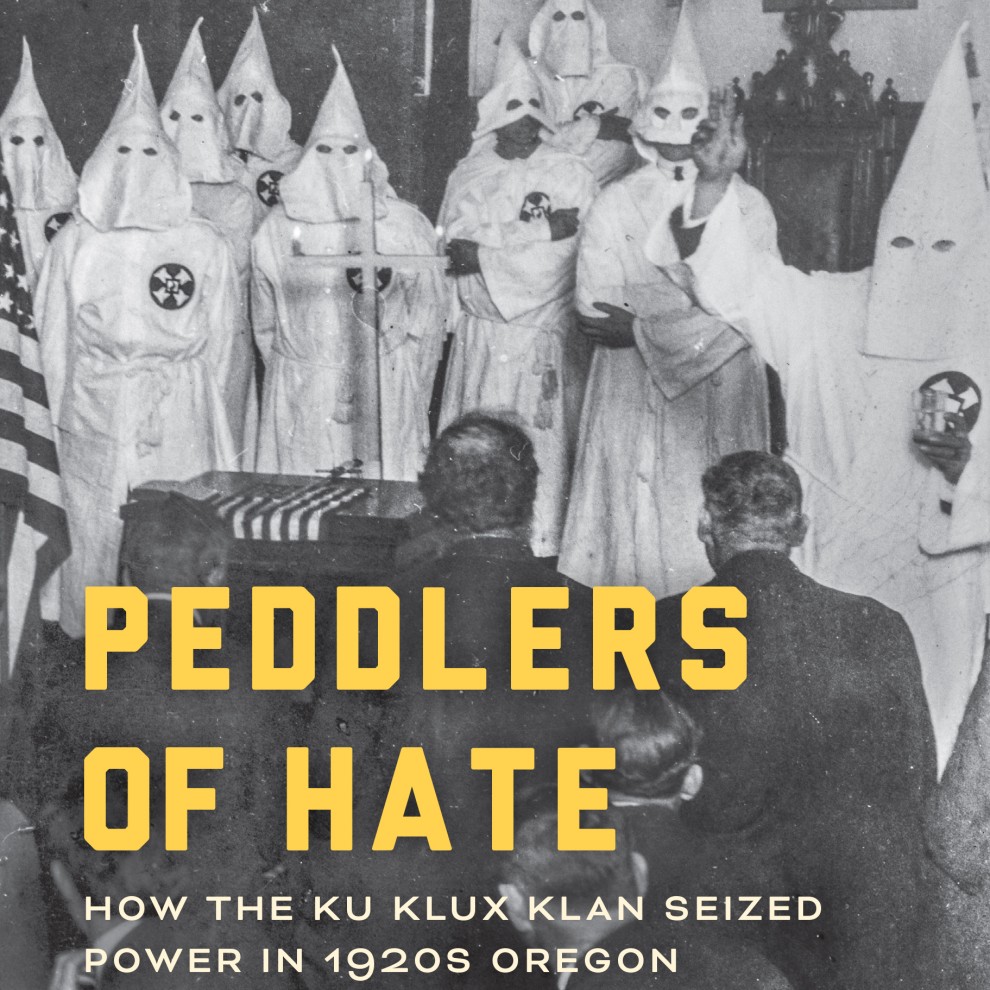
“Peddlers of Hate: How the Ku Klux Klan Seized Power in 1920s Oregon,” published by Oregon State University Press, details the rise, prominence and eventual downfall of the notoriously racist and antisemitic organization in Oregon politics. Law will discuss the book and its subject matter at Powell’s Books in downtown Portland Wednesday, Aug. 26 at 7 pm.
Mount Tabor was a hub of Klan activities during its heyday, including cross-burnings and an attack on immigrant laborers from China. Inspired by a podcast from Alabama civil rights leader Brian Stevenson, Law began working on signage for the Mount Tabor area alongside the Oregon Remembrance Project marking the first lynching in the state of Oregon. That process spurred further research and, eventually, a six-part series of features published by the Portland Tribune, from which Law had retired, in 2022 – the centennial of elections that gave the KKK a decisive grip on political power in the area.
“They convinced voters to ban private schools and knocked off a sitting governor and sitting congressman and took over the legislature,” Law said of the Klan’s impact on the 1922 elections. “They took over Multnomah County Commission, and the mayor of Portland was a collaborator and did whatever they wanted.”
Law said the series got perhaps the best reception of anything he had written in his career, which included time in public radio and smaller papers in the Portland suburbs leading to positions at the Portland Business Journal and the Statesman Journal before closing on an 11-year stint at the Tribune. Once the series concluded, someone suggested to Law that it would make a good topic for a book.
“It’s the first book length treatment of the Klan in Oregon, Law said. “There’s been three or four theses for master’s and even a bachelor’s thesis about the topic, but nothing published in book form that’s a comprehensive look at what the Klan did in the 1920s in Oregon.”
Covering events a hundred years after they’ve occurred poses a challenge for traditional reportorial methods, with hardly anyone living who remembers events and memories known to get fuzzy with time. Law was undeterred.
“I scoured everything at the Oregon Historical Society,” he said “The University of Oregon has some archives, the historical archives in Medford. I called some other museums and talked to them about their collections.”
Law also realized that those century-old occurrences would have been covered by the reporters of their day.
“I decided that the best source was probably going to be stuff written at the time,” he said. “A lot of people don’t call that a primary source, but I kind of think they’re kind of pretty close to primary because these people were writing right as events were happening, and that’s as good a documentation as we often get.”
Many papers of the day were either controlled by the Klan or afraid of losing subscribers by going after them, but the Catholic Sentinel and Oregon Northwest Labor Press proved valuable, along with the Portland Telegram, one of few mainstream papers that took on the KKK.
While the Klan is best known for anti-Black racism in the American South, the group tailored its focuses on whatever would play locally. In Oregon, they directed much of their ire at Asian immigrants and Catholics; the Klan-supported ban on private education passed in the 1922 election was conceived as an attack on parochial schools run by the Catholics. The KKK was also, of course, wildly antisemitic, but Law’s research found that the level of social acceptance Jews had found in Oregon at that time deterred some of the Klan’s worst rhetoric. Nevertheless, the KKK did lobby against Portland hosting a World’s Fair exposition almost solely because it was supported by Meier & Frank department store scion, civic leader and future Governor of Oregon Julius Meyer.
“The interesting thing is their antisemitic line was kind of schizophrenic,” Law said of the Klan. “Jews were either Bolsheviks trying to overthrow capitalism, or they were Shylocks, ripping people off because they were such successful capitalists.”
“Peddlers of Hate” is available at Powells and other major booksellers. For more information about Law’s upcoming appearance at Powell’s, which is free to attend, visit powells.com/events/steve-law-9781962645706.