
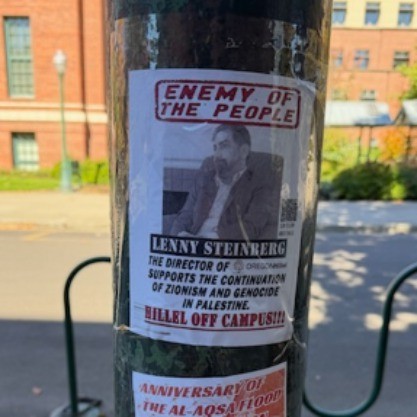
A poster spotted on the University of Oregon campus attacking the head of Oregon Hillel has drawn condemnation from campus leaders, elected officials and Jewish community leaders throughout the state.
Early in the afternoon of Saturday, Oct. 1, Oregon Hillel Executive Director Lenny Steinberg learned that a poster has been spotted near the intersection of East 13th Avenue and Kincaid Street at the western edge of the University of Oregon’s Eugene campus, branding him an “enemy of the people,” accusing him of supporting genocide and demanding the exclusion of Hillel from the university campus. Steinberg received a message from a colleague who had learned about the poster from a student.
“Sadly, one of the feelings and things that went through my head was, ‘Not too surprised here. This is the world we live in,” Steinberg said. Then you start thinking to yourself, ‘Am I safe? Am my family safe? Are students safe? What needs to be done? Who do I need to contact? Who do I need to let know? What’s the playbook for this? Because this kind of antisemitism and hate, it’s happened, but I am one of very few Hillel professionals that this has ever happened to.”
Steinberg said he later learned from the University of Oregon Police Department that security camera footage identified a pair of individuals post the flyer in the location where it was observed by the Hillel student, near the Lillis Business Complex, and at additional locations on campus before leaving UO property. The two individuals were dressed entirely in black and were wearing masks that concealed identifying features.
“There’s a very good likelihood this is community members and outside people from the university,” Steinberg said. “They’re completely masked up. They know what they’re doing. They know that there’s cameras on site. We’ll never be able to identify them and actually know who these people are.”
By that evening, Sens. Ron Wyden and Jeff Merkley and Rep. Val Hoyle, whose district includes the UO campus, released a joint statement on Facebook condemning the flyers.
“We should all unequivocally condemn the antisemitic targeting of Oregon Hillel and its Executive Director on the University of Oregon campus. Targeting Hillel and its leadership with this hateful rhetoric is a blatant effort to intimidate and demonize a Jewish organization and the Jewish students it represents. We stand firmly with Oregon Hillel and Jewish students across Oregon,” the statement read in part. “Hate, intimidation, and antisemitism have no place on our college campuses, in our state or our country.”
Sunday morning, Jewish Federation of Greater Portland President and CEO Marc Blattner said in an email to community members, “We want Lenny, Oregon Hillel’s professional team, and students to know they are not alone. The Jewish Federation of Greater Portland, and our community, stand behind them, and we are ready to offer whatever support they need.”
“All Oregonians should be deeply disturbed by this,” the email continued. “Hillel is a home for Jewish students, a place to gather for Shabbat, celebrate holidays, find community, build lifelong friendships, and, most of all, spread Jewish joy. When that home and the people who lead it become targets of open hostility, the message to Jewish students on campus is unmistakable.”
On Monday, UO President Karl Scholz said in a statement that “this type of language on our campus—language that targets based on religious and ethnic identity—is reprehensible. People have the right to speak freely, and we uphold that right. The posted flyers did not invite dialogue; instead, they promoted isolation and fear, and fear erodes the foundation of our community.”
Steinberg was quick to point out that calling to exclude Hillel from campus is a blatant attempt to erase Jewish community from the university.
“When we try to help under, help people understand why anti-Zionism is just a facade and a placeholder for antisemitism, this is it right here,” he told The Jewish Review. “I try very hard to walk this careful line of ‘Are we in the 1930s again? Are we seeing the writing on the wall?’ Because they’re telling the Jews to get out. That’s one of the most hurtful pieces to all of this.”
While the experience of being targeted has been hurtful, there has also been an outpouring of support from all corners of the community, Jewish and otherwise.
“I never thought that, no matter what position I held, I would be getting calls from senators and congresswomen and just people with much more highly visible profiles than I have, coupled with family and friends, current students, former students, alumni that I never met, parents, people in the Jewish community and Jewish professionals that I have no connection with other than we all work in the Jewish professional world reaching out,” he said. “I’ve been so inundated by love and support and it’s overwhelming.”