
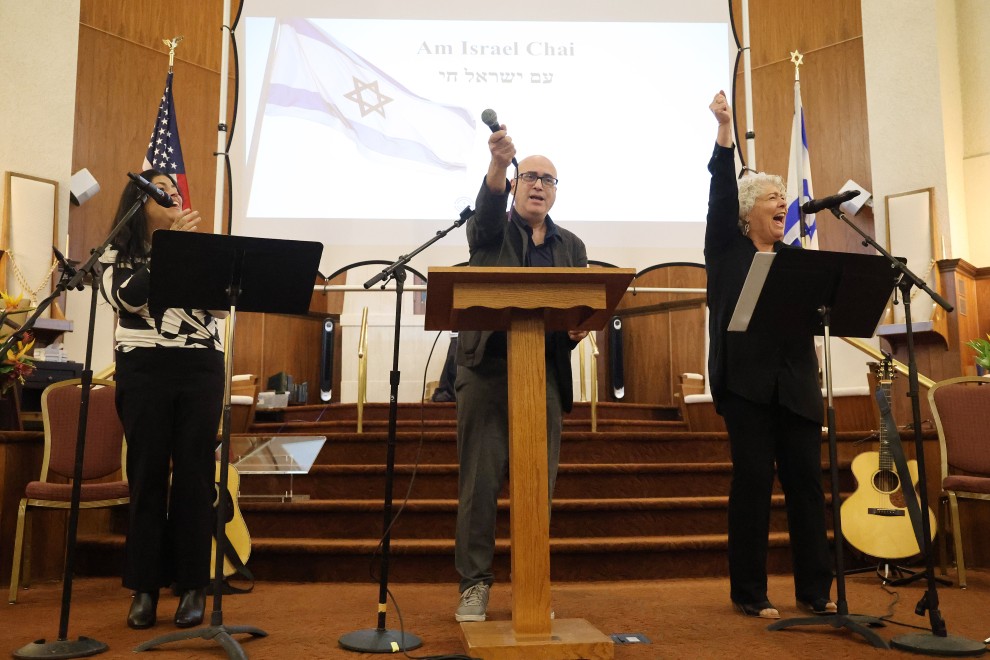
PHOTO: From left, Kim Schneiderman, Cantor Eyal Bitton and Ilene Safyan lead the singing of "Am Israel Chai" at the Jewish Federation of Greater Portland's Sunday, Oct. 19 celebration of the release of hostages at Congregation Neveh Shalom. (Rockne Roll/The Jewish Review)
Because of the different organizational formulas between the Hebrew and Gregorian calendars, in 2025, more than a week separates Oct. 7 and 22 Tishrei; days that were the same two years ago when Hamas attacked Israel from Gaza.
What a difference a week makes.
The Jewish Federation of Greater Portland, joined by congregations and organizations across Portland marked the second year since the attacks with a memorial service at Congregation Neveh Shalom Sunday Oct. 5.
“We cry with one singular voice, ‘Bring them home now,’” Neveh Shalom Senior Rabbi Eve Posen said that evening. “Bring them home to embrace their loved ones, to restore their lives, to remind the world that each and every soul is precious.”
Five days later, a ceasefire between Israel and Hamas, orchestrated by the United States and other nations, came into effect and all 20 living hostages held by Hamas were released.
Nine days after that, on Sunday, Oct. 19, the Federation once again held a community gathering at Neveh Shalom. Once again, Rabbi Posen spoke.
“In that solemn moment,” she said, referring to her remarks of two weeks prior, “I stood here with the faintest spark of hope that I would soon be here again, this time with blessings of return on my lips, and tonight, hineni, we are here.”
The latest gathering wasn’t of celebration alone. As Rabbi Posen explained, as Ilene Safyan sang and as the event was titled, this was a moment al ha’dvash ve’al ha’oketz; for the honey and the sting.
“We hold in this moment two truths, the miracle of life restored and the heartbreak that through it all, it is still not finished. There are still those who need to be returned,” Rabbi Posen said.
-
As the gears of foreign policy and international relations turned slowly a continent away, a world away, there was a sense that two years of waiting, hoping, and praying may be reaching a conclusion at the Oct. 5 gathering, held just as the details of the ceasefire and hostage release were coming together.
“It’s hard to believe that we can even talk about hope, but perhaps, perhaps, perhaps we won’t have to say, ‘bring them home now,’ Congregation Beth Israel Senior Rabbi Michael Cahana said that evening. “Perhaps they will be home this Sukkot, perhaps even in a few days, we can dare to dream. We pray, G-d, may it be so.”
Most of that evening was devoted to remembering those who had fallen two years ago and those who gave selflessly of themselves that day to protect and save others.
Federation President and CEO Marc Blattner told the assembled crowd about Aner Elyakim Shapiro, z”l, a 22-year-old man who was attempting to return to his Israel Defense Forces unit as the attack unfolded.
“He instead found refuge in a public shelter, together with approximately two dozen civilians fleeing the assault,” Blattner recounted. “As the terrorists approached and began launching grenades and gunfire, Aner positioned himself at the doorway of the shelter. Time and time again, he threw the live grenades back out, seven in total, sacrificing his safety to protect others.”
The eighth exploded in his hands, killing him.
“Anir’s story is one of true courage in the face of evil, he will forever be remembered as a hero who gave his life so others could live,” Blattner continued.
Noga Vilan, who led weekly demonstrations on behalf of the hostages, spoke about Inbal Liberman, the security coordinator of Kibbutz Nir Am in the Gaza Envelope. After losing electricity, Lieberman ordered that it stay cut to prevent the kibbutz’s electric gate from opening. She and her 11-person team held off Hamas terrorists for 18 hours.
“Inbal and her team’s courage and coordinating helped prevent the terrorists from breaching the kibbutz, saving countless lives,” Vilan said.
Michelle Bombet Minch, Co-Chair of the Jewish Community Relations Council’s Israel Advocacy Committee, shared the story of Amit Mann, z”l. Maan, 22, was a paramedic with Magen David Adom, and though she could have fled to her mother’s home on the morning of the attacks, she reported to a community clinic at Kibbutz Be’eri to aid the wounded.
“When she was shot in the leg, Amit did not give up. She tied a tourniquet on herself so she could keep helping others. Only later, when she was shot again, did her young life come to an end,” Bombet Minch recounted. “She will always be remembered as someone who gave everything to save lives.”
Efrat Avsker spoke of one of Oct. 7’s heroes close to her heart – her brother, Ohad Yahalomi, z”l, who was murdered by Hamas in his family’s home, trying to protect them from the onrushing terrorists.
“He left behind a legacy of goodness, humility and compassion, one that will guide us for years to come,” Avsker said. “Before I finish, I want to say a few words about hope, because even in these painful days, there is still a small light in the air, a sense of hope. For the return of all the hostages. For the end of this war. For the soldiers to come home safely to their family. Maybe, then maybe finally, we’ll begin to heal as families, as a nation and as human beings.”
-
Those hopes, of course, have begun to be fulfilled.
“There is a time to tear and a time to heal, and we need to do both right now. There is a time to be silent. And a time to speak, a time to sob, and a time to dance, and we need to do both right now,” Rabbi Posen said on Oct. 19, quoting Rachel Goldberg-Polin. “Her words are weary and honest and unguarded, and they name exactly where we stand; between anguish and relief, between mourning and song. Tonight, we make room for the tearing, but more so for the healing.”
There was appreciation for the moment, give communal voice in the recitation of the Shehecheyanu, the blessing for that which “has granted us life, sustained us and enabled us to reach this moment.” Simultaneously, there was acknowledgement that the moment was not an uncomplicated one.
“This is not a simple joy,” Beth Israel Senior Rabbi Designate Rabbi Rachel Joseph said. “It’s a joy laced both with memory and a joy laced with mourning. It’s the fulfillment of our most desperate prayers that they come home alive and reminder of all who did not return, and all that was shattered in these long two years. So, as we watch, let us feel it all. Let us feel the immense gratitude and let us feel the immense grief. We feel the exhaustion, and we feel the amazement, and we hold it all together, only as our people can.”
There was also hope – the hope of 2,000 years, in the words of HaTikvah, the hope of two years and a week and a new hope embodied in Allison Fowler’s poem, “Prayer That This Be True.”
“Let us exhale, exhale in relief and inhale in renewal,” the poem, recited by Blattner, reads in part. “Let Oct. 8 begin for those in Israel, when they can begin to heal. Let us reclaim Simchat Torah, back into a night of rejoicing with our precious Torah and with each other. May the coming days bring healing to the wounded, comfort to the bereaved, and peace, true and lasting peace to Israel and to all who dwell upon this earth.”