
What passes for involvement in public life looks different today than it did in the recent past.
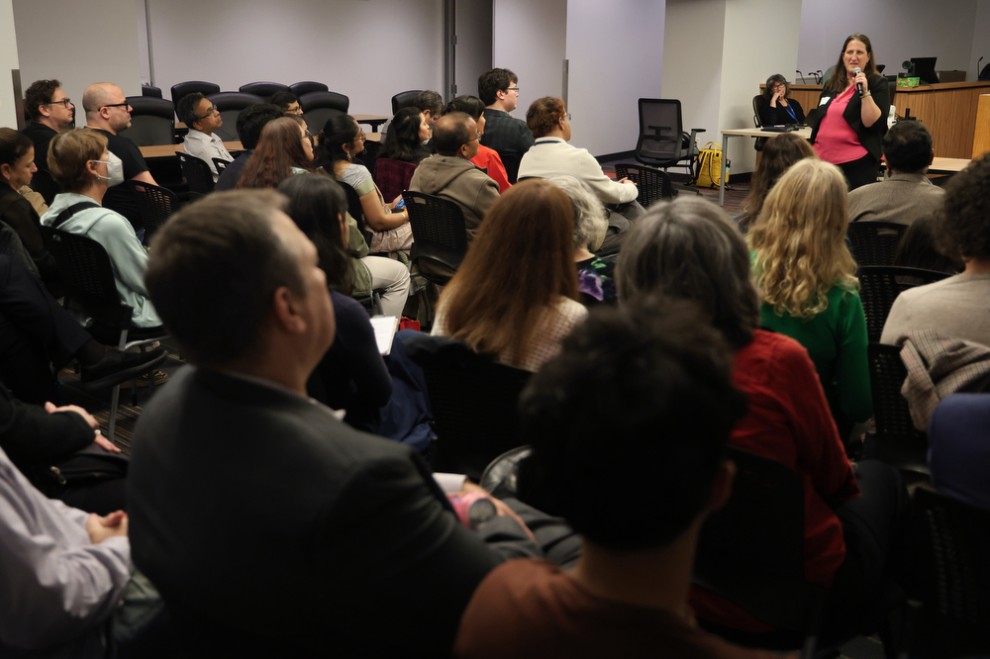
“I think we’ve lost so much of that in in so many different ways over the last decades and years. And I want to reengage and I want to reinvigorate that,” Jewish Federation of Greater Portland Chief Planning Officer and co-organizer of last Thursday’s Avenues of Civic Engagement program in Beaverton said at the event.
For more than two hours, elected officials and community leaders spoke at the program, sponsored by the Federation and Hindu community organization Hindu Swayamsevak Sangh and funded by a grant from Jewish pro-democracy non-profit More Perfect Union. They discussed how to get involved, why getting involved is essential in 2026, and the potential consequences of failing to do so.
One of the program’s key points was that becoming involved in public life and the political process doesn’t require running for elected office. But sometimes things take a different course; just ask State Treasurer Elizabeth Steiner.
Steiner, a primary care physician, first got involved in the political process in 2002 when the legislature proposed a ballot measure implementing a single-payer healthcare system in the state. The measure was written without input from primary care doctors, Steiner said, because all the doctor’s voices influencing the legislature on health care policy were specialists. Steiner worked to change that, becoming deeply engaged in health care advocacy.
“That is how I ended up where I am today,” she said. “Because when you start spending a lot of time talking with legislators, you start to realize that you have something to bring to the table.”
She soon joined the table – more than a decade in the state Senate has been followed by serving as Treasurer. Steiner counseled attendees in the easiest form of engagement: knowing who your elected officials are and connecting with them.
“When you go home tonight, go to the Oregon Legislature’s website and click on Find Your Legislator. If you don’t already know who your state representative and your state senator are, you should. If you don’t know who your city council people are, you should. Figure that out and send them an email saying ‘Hi, I’m your constituent. I want to be on your mailing list. I want to know what’s going on,’” Steiner said. “The stronger you are in building those relationships, the more effective you’re going to be in helping move the conversation forward in ways that are congruent with your values and with what’s important to you.”
When Steiner was a senator, she provided the first endorsement for the mayoral campaign of Lacey Beaty. Beaty, at the time a city councilor in Beaverton, moved to the area after leaving the army and joined the city’s Visioning Advisory Committee as a way to connect. That led to the city council, then to the mayor’s office.
“I had a really hard time finding my footing after my service, because you are surrounded by people that have the similar mission to you, and understanding daily your life means something,” she told the audience via Zoom from San Diego, where she was attending a meeting of the U.S. Conference of Mayors Leadership Board.
“What you need to do to make sure that your kids continue to live in the safest city and school district is to sign up for a board - that’s where decisions are made,” Beaty said. “Sign up and do the work.”
One small but highly influential way of getting involved is as a precinct committee person for a political party.
While political parties are most noticeably organized at the state and county level, the base organizational level of each party is a precinct. There are more than 150 voter Precincts in Washington County, for example, and each party has an organizing committee in each precinct which party members can be elected to. Each precinct has a certain number of seats on its committee; this number is often larger than the number of people interested in serving on the committee.
Rebecca Cambreling is a Democratic PCP in Washington County – she said she received eight votes for the position at her last election. PCPs can also be appointed by the party if seats are available – as they often are. Despite the job’s low profile, it is highly influential.
“There’s a lot of politicking happening behind the scenes within the Washington County Democrats, within the Democratic Party of Oregon,” Cambreling said, “and the only way to make sure that what’s happening aligns with the values that we hold, no matter what your values are, is to get in there.”
PCPs elect party leadership, who then select leaders at the next level, culminating in Nathan Soltz, the chair of the Democratic Party of Oregon.
“We are built bottom up, and that is not just a metaphor. That’s very literal. That is our structure. Change in the Democratic Party, certainly at the state level, at the county level, is not top-down. It is all about the grassroots,” he said. “It’s about who shows up in those spaces. It’s about who is signed up to have their voices heard, and that’s where the precinct committee people come in. And even at this point, it is something that you all can do immediately.”
The imperative to get involved comes from the simple reality that someone else will, or already has, and their views may be unfriendly to your views – or your very identity.
“Recently, we’ve seen a handful of county Democratic parties adopting inflammatory and divisive anti-Israel resolutions that they hope that they could bring to the Democratic Party of Oregon, and unfortunately, when it came time for the discussion and the debate and ultimately to vote, we were greatly outnumbered by the proponents of those resolutions,” Federation Chief Community Relations and Public Affairs Officer Bob Horenstein said.
It’s a symptom of a changed political landscape, Beaty, the mayor of Beaverton, said.
“What’s been happening in politics over the last, I would say, two years, really from the first Trump administration to now, is this idea that we don’t have to be humans to each other anymore; that if I disagree with you about one thing, that we’re enemies,” she said. “I sit at the dais and hear all kinds of feedback from the community, and it used to be about things that I could control: potholes, the budget. Now it’s wars in foreign countries; ‘What’s your stance on this? If we don’t share the same stance on everything that our agreement means nothing.’”
Oregon Public Broadcasting reported on the broader impacts of that shift in Washington County, including a harassment incident at a community event held by State Sen. Janeen Sollman, who was defeated by a Democratic Socialists of America-back challenger, Myra Munoz, in May’s Democratic primary, and an obscene gesture by Washington County Chair Kathryn Harrington directed at Nafisa Fai, a current county commissioner who is running to replace Harrington. Harrington has since announced her resignation.
Much of the controversy in Washington County’s coming elections revolves around the presence and growth of data centers, as OPB reported, but Munoz is just one of a cadre of candidates backed by the DSA, which has heavily promoted anti-Israel messaging and positions.
It’s an issue that’s not lost on Soltz, who spearheaded the creation of the DPO’s Jewish caucus.
“I’m Asian. I’m Hispanic. I’m gay. But the most prejudice that I have ever faced is for being Jewish,” he said. “Unfortunately, within the Democratic Party, that is true tenfold.”
It’s also true at the grassroots level, in those often unseen but important precinct committee meetings. Cambreling discussed the rise of an activist element within her precinct and the county party that she did not name but spoke stridently about.
“The problem is they are loud and they are overly vocal and they are rude and they spin things,” she said. “But what I have noticed is that they show up every meeting and they get themselves elected because they are the ones who have people knocking doors because of the fervor. It is something like akin to what we see, no offense here, in the MAGA world where you’ve got people who are ‘Party and Trump above what’s right and country’ and I see that in this sect, but it goes the other way.”
The issue is about numbers – Soltz reiterated that the solution is the same.
“That we’re seeing some bad things coming out of the Washington County Democrats, from other county parties, it’s because the people who are making those decisions that we don’t like are the ones who have organized, and they are showing up,” he said. “We can do that, too. Then we’re not going to be upset about the party anymore because we will be the party.”
Whether it’s connecting with elected officials, serving on boards or committees, working within a political party or even running for office, the biggest key is the same; each presenter reiterated: showing up.
“You just have to speak up,” Gauri Joshi, who presented on her engagement with her area school district, said. “The more voices that speak, the more people will hear, and the more they hear, that change will come in policy.”
PHOTO: Nelson presents at Thursday's event. (Rockne Roll/The Jewish Review)